Rigid Building Systems vs Pre-Engineered Steel Buildings: Key Differences for Commercial Projects
When planning a commercial construction project in the Houston area, understanding the steel building systems available to you is one of the most important early decisions you’ll make. At Questar Construction, we work with clients every day who come in asking the same question: what’s the difference between rigid frame building systems and pre-engineered steel buildings – and which one is right for my project? We’ve broken down both systems so you can move forward with confidence.
Key Takeaways
- Rigid-frame systems are built for wider clear spans (up to 100 ft and beyond) and heavier loads, making them the structural backbone of most large warehouses, industrial facilities, and commercial buildings.
- Pre-engineered steel buildings – which incorporate rigid frame technology in a factory-engineered, turnkey package – are faster to deliver, more cost-effective, and the right solution for the vast majority of commercial projects.
- The best choice depends on your project’s size, load requirements, budget, and timeline. For most commercial clients in Houston, a pre-engineered metal building from Questar Construction delivers the best combination of performance and value.
Understanding Building Systems
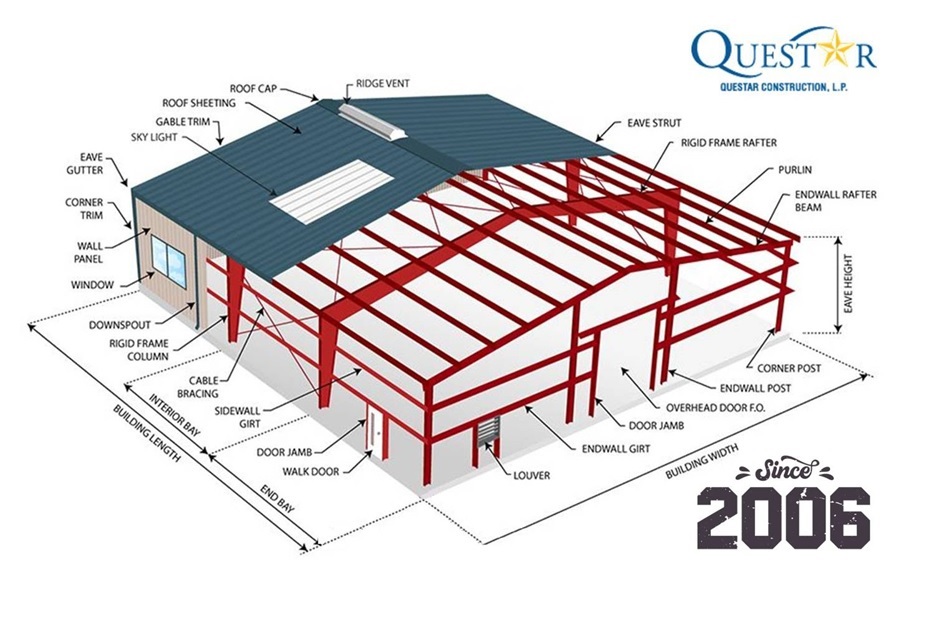
When we talk about commercial steel construction, the structural system underneath the building is everything. Rigid building systems are one of the most important concepts in metal construction – and understanding them is key to making the right call for your project. A rigid frame is built with connections that resist movement, allowing the beams and columns to transfer and distribute significant stress, including bending forces. The result is a building that can achieve wide-open interiors without relying on a forest of interior columns – a major advantage for businesses that need operational flexibility.
Defining Rigid-Frame Construction
Rigid-frame construction uses heavy steel members – typically hot-rolled or built-up sections – joined together by welding or high-strength bolting to create a continuous, integrated structural unit. Rather than a collection of separate parts each doing their own job, a rigid frame behaves as a single cohesive system. The members are tapered and shaped to carry the most steel where stress is highest and trim it where loads are lighter, which is an efficient use of material.
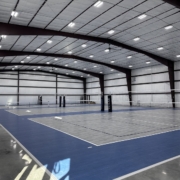
This engineering principle is what makes those wide, column-free interiors possible – the kind you see in large warehouses, distribution centers, aircraft hangars, and manufacturing plants. It’s also the same structural concept that forms the core of pre-engineered metal building systems, which is why the two are so closely related.
Key Advantages of Rigid Frame Systems
- Wide Clear Spans: Rigid-frame buildings routinely achieve 100+ ft of unobstructed interior space – no columns in the way of your operations.
- Heavy Load Capacity: Engineered for crane systems, tall clear heights, and demanding wind and live loads common in Houston-area industrial projects.
- Design Flexibility: Accommodates varied roof slopes, eave heights, and exterior finishes – brick, glass, stucco, or metal panel – without compromising structural performance.
- Long-Term Durability: Steel resists rot, pests, and warping. Long paint and structural warranties mean low maintenance costs over the life of the building.
Key Advantages of Pre-Engineered Steel Buildings
- Faster Delivery: Factory-manufactured components ship in 6-12 weeks and erect quickly, getting your building operational sooner.
- Lower Overall Cost: Optimized material use and factory efficiency reduce waste and labor, delivering more building per dollar.
- Turnkey Simplicity: At Questar Construction, pre-engineered buildings are delivered as a complete package – from site development and engineering through erection and interior build-out.
- Built to Local Codes: Every system is engineered to meet IBC wind, load, and seismic requirements for the Greater Houston area.
Comparing Rigid Building Systems with Pre-Engineered Steel Buildings
Here’s where the common confusion lives. When clients ask about “rigid building systems” versus “pre-engineered steel buildings,” they’re often treating them as two entirely separate things. The reality is more nuanced – and understanding it helps you make a much better decision.
Most pre-engineered metal buildings (PEMBs) use rigid-frame systems as their primary structural framework. The difference isn’t the structural concept – it’s how the building is designed, manufactured, and delivered. Pre-engineered buildings take the proven engineering of a rigid frame and combine it with factory production, optimized material usage, and a complete turnkey package that arrives at your job site ready to erect.
That said, there are also pre-engineered building systems that use cold-formed steel – thinner, lighter steel sections rolled into C- and Z-shapes at room temperature. These systems are faster and cheaper for smaller applications but carry meaningful limitations in span and load capacity.
Span Capabilities and Load Bearing
Span and load capacity are often where the decision gets made. Cold-formed steel pre-engineered buildings are well-suited for compact structures – small workshops, garages, or single-story retail spaces – and typically max out around 70 feet in clear span width. They handle lighter loads comfortably but aren’t the right structural answer for demanding commercial or industrial applications.
Rigid-frame steel systems – whether custom-fabricated or delivered as part of a pre-engineered package – routinely achieve clear spans of 100 feet or more, with some configurations reaching 300 feet. They handle heavy crane loads, tall clear heights, and challenging wind and weather conditions with ease. For Questar Construction’s commercial clients, rigid-frame pre-engineered buildings are the standard solution for warehouses, office/warehouse combinations, industrial facilities, and specialty-use buildings throughout the Houston area.
| Feature | Pre-Engineered Cold-Formed Steel | Rigid-Frame Pre-Engineered Steel |
|---|---|---|
| Max Clear Span | Up to 70 feet | Up to 300+ feet |
| Load Capacity | Light to moderate | Moderate to heavy |
| Crane Ready | No | Yes |
| Best For | Small garages, shops, storage | Warehouses, industrial, commercial |
| Erection Speed | Fast | Fast (factory pre-cut components) |
| Long-Term Value | Good for small structures | Superior for commercial projects |
Cost, Lead Times, and Installation Differences
Cost is always part of the conversation, and here’s an honest breakdown. Cold-formed steel pre-engineered buildings carry a lower upfront price tag – lighter materials, simpler foundations, and faster erection translate to lower initial cost. For small, straightforward structures, this is a genuine advantage.
Pre-engineered rigid-frame steel buildings require more steel and more substantial foundations, which means higher initial investment. However, for commercial projects where clear span, load capacity, and long-term functionality matter, that investment pays off significantly. Factory engineering eliminates material waste. Pre-cut, pre-drilled components mean fast, predictable erection with minimal field adjustment. And a building that serves your operational needs for 30+ years without costly modifications is almost always the better financial decision over the life of the asset.
Questar Construction’s value engineering process is specifically designed to get the most performance out of every dollar spent. We don’t just build buildings – we design them to maximize your return on investment from day one.
Here’s how these differences typically play out on real projects:
- Pre-Engineered Cold-Formed: Faster fabrication and erection, simpler foundation requirements, lower upfront cost. Best when speed and budget are the primary drivers for a small, low-load structure.
- Pre-Engineered Rigid-Frame: Fast erection using factory-manufactured components, designed for large clear spans and heavy loads, superior long-term value. The right choice for virtually all commercial and industrial applications – and what Questar Construction specializes in delivering.
Ideal Use Cases for Each System
Choosing the right system comes down to what you’re building and how you intend to use it.
If your project is a small personal storage building, an oversized residential garage, or a compact single-bay shop, and speed and upfront cost are your primary criteria, a cold-formed pre-engineered system may get the job done.
For any serious commercial application – a distribution warehouse, a manufacturing facility, an office/warehouse combination, a commercial strip center, an aircraft hangar, a crane building, or a barndominium designed for long-term use – a pre-engineered rigid-frame steel building is the clear choice. These buildings deliver the structural capacity, design flexibility, and long-term durability that commercial projects demand. And with Questar Construction managing the full process – from site development and engineering coordination through steel erection and interior build-out – you get a turnkey solution with a single point of accountability.
Contact Questar Construction Today
Choosing between rigid building systems and pre-engineered steel comes down to understanding what your project actually requires. Rigid-frame systems deliver wide clear spans, heavy-duty load capacity, and the structural flexibility that commercial and industrial projects depend on. Pre-engineered steel buildings – particularly those built on rigid-frame systems – combine that structural performance with factory efficiency, faster erection, and value-engineered cost savings that are hard to beat.
For the vast majority of commercial construction projects in the Greater Houston area, a pre-engineered rigid-frame metal building is the right answer. Questar Construction has been delivering turnkey pre-engineered steel buildings since 2006, backed by three generations of real estate development and construction expertise. If you’re ready to move forward – or just want to talk through your options – contact our team today.
Frequently Asked Questions
What exactly is a rigid building system? A rigid building system is a structural steel frame made up of beams and columns that are rigidly connected – meaning the joints resist rotation and bending rather than simply pinning together. This allows the frame to act as a single integrated unit, transferring loads efficiently and enabling wide, column-free interior spaces. Rigid-frame systems are the structural foundation behind most commercial steel buildings, including pre-engineered metal buildings.
How is a pre-engineered steel building different from a conventional rigid-frame building? Most pre-engineered steel buildings (PEMBs) use rigid-frame systems – the key difference is in how they’re produced and delivered. Conventional rigid-frame buildings are custom-engineered and fabricated from scratch, which takes more time and costs more. Pre-engineered buildings are designed and manufactured in a factory using optimized engineering software, then shipped to the job site as a complete kit of pre-cut, pre-drilled components. The result is the same structural performance at a faster pace and lower cost – which is why Questar Construction specializes in pre-engineered metal building systems for commercial clients.
Which type of steel building is better for a large commercial warehouse? For a large warehouse – or any commercial facility that requires wide open interior space, heavy load capacity, or crane-ready construction – a pre-engineered rigid-frame steel building is the right choice. These systems routinely achieve clear spans of 100 feet or more, handle significant operational loads, and deliver the durability and design flexibility that commercial projects demand. Questar Construction designs and builds these structures for clients throughout the Greater Houston area on a turnkey basis.
Can pre-engineered steel buildings accommodate overhead cranes? Yes. Pre-engineered rigid-frame steel buildings are routinely designed to accommodate overhead crane systems – including underhung and top-running configurations. The crane loads are integrated directly into the structural design of the building. Questar Construction has extensive experience delivering crane-ready industrial buildings for Houston-area clients.
How long does it take to get a pre-engineered steel building? Most pre-engineered steel building packages are delivered within 6–12 weeks of approved drawings and deposit. Erection time varies based on building size and site conditions, but the pre-cut, pre-drilled nature of the components makes the erection process significantly faster than conventional steel construction. Questar Construction manages the full timeline – from design and permitting through final delivery – so you always know where your project stands.